
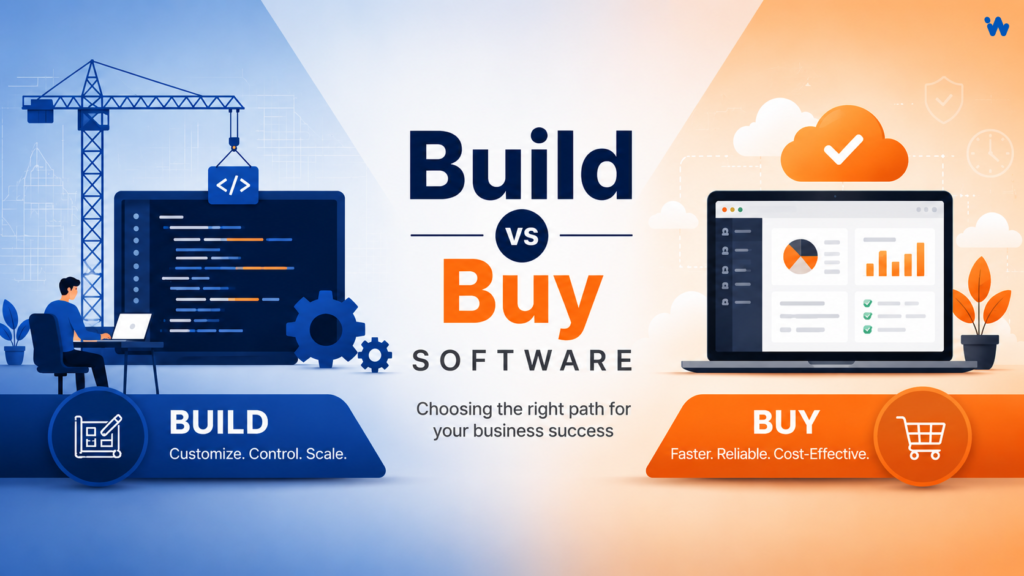
In 2026, the build vs buy software debate is no longer just an IT decision. It has become a core business strategy discussion influencing scalability, operational efficiency, competitive advantage, cybersecurity, AI adoption, customer experience, and long-term digital transformation.
From startups in San Francisco and Bangalore to enterprises in London, Dubai, New York, Toronto, and Sydney, companies are reevaluating whether they should build custom software internally, outsource development, or purchase existing SaaS platforms.
The rise of AI-powered workflows, cloud-native infrastructure, automation platforms, low-code ecosystems, cybersecurity compliance, and rapidly changing customer expectations has fundamentally changed how businesses evaluate software investments.
For many organizations, the wrong decision can lead to:
- Excessive operational costs
- Vendor lock-in
- Slow innovation cycles
- Technical debt
- Security vulnerabilities
- Poor scalability
- Delayed product launches
- Reduced competitive agility
At the same time, the right software strategy can dramatically improve:
- Revenue growth
- Team productivity
- Process automation
- Customer retention
- Market differentiation
- Data ownership
- Long-term profitability
- AI readiness
This guide provides a strategic, enterprise-level framework to help CTOs, founders, HR leaders, operations teams, startups, SMBs, and enterprises make smarter software decisions in 2026.
What Is Build vs Buy Software?
Build vs buy software is the strategic process of deciding whether a business should develop custom software internally or purchase an existing third-party software solution.
The decision typically depends on:
- Business goals
- Budget constraints
- Time-to-market requirements
- Scalability needs
- Competitive differentiation
- Compliance requirements
- Integration complexity
- Long-term maintenance costs
Businesses usually evaluate build vs buy software decisions for:
- CRM systems
- HRMS platforms
- ERP software
- AI automation tools
- SaaS platforms
- Mobile applications
- Enterprise workflow systems
- Healthcare software
- FinTech products
- Logistics platforms
Why the Build Software vs Buy Software Debate Matters More in 2026
The software landscape has evolved significantly over the past few years.
Traditional SaaS platforms are becoming increasingly standardized, while AI-driven customer experiences demand deeper customization and automation capabilities.
At the same time, businesses are facing:
- Rising cybersecurity threats
- Complex compliance regulations
- AI integration pressure
- Multi-cloud infrastructure challenges
- Global workforce management needs
- Industry-specific operational demands
This means organizations can no longer make software decisions based solely on upfront pricing.
They must evaluate:
- Strategic control
- Data ownership
- AI adaptability
- Operational flexibility
- Future scalability
- Vendor dependency risks
- Long-term innovation potential
A growing number of businesses are now adopting hybrid approaches where they buy core infrastructure but build competitive differentiators.
Search Intent Behind “Build vs Buy Software”
Primary Search Intent
Commercial investigation.
Users searching for build vs buy software are actively evaluating software investment decisions before selecting a development strategy, technology partner, or SaaS platform.
Secondary Search Intent
- Cost comparison
- Strategic planning
- Technology consulting
- Risk analysis
- Software outsourcing evaluation
- Vendor comparison
- AI software planning
- Enterprise modernization
Decision-Making Stage
Most users are in the middle-to-late consideration stage.
They are already aware of software modernization needs and are trying to determine:
- Whether custom development is justified
- Which approach provides better ROI
- How to reduce implementation risk
- Which strategy aligns with long-term growth
Build Software vs Buy Software Comparison Table
| Factor | Build Software | Buy Software |
| Initial Cost | Higher upfront investment | Lower upfront cost |
| Time to Deploy | Longer | Faster |
| Customization | Unlimited | Limited |
| Scalability | Fully controllable | Vendor-dependent |
| Maintenance | Internal responsibility | Vendor-managed |
| Competitive Advantage | Stronger differentiation | Limited uniqueness |
| Security Control | Full ownership | Shared/vendor controlled |
| Integration Flexibility | High | Moderate |
| Long-Term Cost | Can become lower over time | Subscription costs increase |
| AI Integration | Highly customizable | Restricted by vendor roadmap |
| Compliance Flexibility | Easier industry adaptation | Vendor limitations |
| Vendor Lock-In | Minimal | High risk |
When Businesses Should Build Custom Software
Custom software development becomes strategically valuable when the software directly impacts competitive advantage, operational efficiency, or unique customer experiences.
Businesses Should Consider Building Software If:
- Their workflows are highly specialized
- Existing SaaS tools create operational bottlenecks
- AI integration requires custom architecture
- Data ownership is mission-critical
- Scalability requirements are complex
- Security and compliance standards are strict
- They need deep system integrations
- Their software is part of the product itself
Common Industries Choosing Custom Development
- FinTech
- Healthcare
- Logistics
- Manufacturing
- EdTech
- HRTech
- SaaS startups
- AI automation companies
- Enterprise workflow platforms
Companies investing in custom software often work with experienced partners offering:
- Custom Software Development
- Cloud Native Application Development
- AI Integration Services
- DevSecOps Services
- Offshore Development Teams
- Dedicated Engineering Teams
Businesses looking to accelerate delivery while reducing engineering overhead frequently partner with an experienced IT Outsourcing Software Development Company like innov8world.
Strategic Benefits of Building Software
1. Full Business Alignment
Custom software adapts to your workflows instead of forcing teams to adapt to rigid third-party systems.
This becomes especially important for:
- Enterprise operations
- HR automation
- Supply chain workflows
- AI-powered decision systems
- Customer lifecycle automation
2. Stronger Competitive Advantage
Off-the-shelf platforms are available to everyone.
Custom software enables organizations to create unique operational capabilities competitors cannot easily replicate.
This is particularly valuable for:
- AI-driven SaaS products
- Customer experience platforms
- Workflow automation systems
- Data intelligence tools
- Industry-specific operational systems
3. Better AI Integration Flexibility
AI adoption is accelerating across the USA, India, UK, UAE, Canada, and Europe.
Companies increasingly require:
- Custom AI workflows
- Internal LLM integrations
- Predictive analytics
- AI automation pipelines
- Intelligent recommendation systems
- AI agents for enterprise operations
Generic SaaS platforms often limit AI customization.
Custom-built systems allow businesses to integrate advanced AI models and automation frameworks more effectively.
Organizations investing in artificial intelligence and AI in Software Development are increasingly prioritizing custom infrastructure.
4. Long-Term Cost Efficiency
Although custom software involves higher initial investment, subscription-heavy SaaS ecosystems can become significantly more expensive over time.
This is especially true for:
- Large enterprises
- High-volume user environments
- Global operations
- Multi-department deployments
- Rapidly scaling startups
5. Improved Security and Compliance
Industries such as healthcare, finance, insurance, and logistics often require:
- Advanced data governance
- Compliance customization
- Secure access controls
- Region-specific hosting
- Audit-ready workflows
Custom software provides more control over:
- Security architecture
- Encryption standards
- Access management
- Compliance policies
- Data residency requirements
Businesses prioritizing Cybersecurity in Software Development and DevSecOps Services increasingly prefer custom-built platforms.
Hidden Challenges of Building Software
Many articles romanticize custom development while ignoring operational realities.
In practice, building software introduces several strategic and execution risks.
1. High Initial Investment
Custom software development requires:
- Product planning
- UI/UX design
- Architecture engineering
- QA testing
- DevOps infrastructure
- Security implementation
- Long-term maintenance
Depending on complexity, enterprise software projects can range from tens of thousands to millions of dollars.
Organizations often evaluate:
- software development cost
- AI development cost
- Web App Development Cost
- Mobile App Development Cost India
- MVP App Development Cost
before making investment decisions.
2. Longer Time-to-Market
Custom software takes time.
Businesses must account for:
- Discovery phases
- Product validation
- Technical architecture
- Sprint development
- Testing cycles
- Deployment workflows
- Iterative optimization
For startups under investor pressure, slow execution can become a major risk.
3. Talent Acquisition Challenges
Hiring and retaining experienced developers remains difficult globally.
Many companies struggle to recruit:
- AI engineers
- DevOps specialists
- Cloud architects
- Security engineers
- Full-stack developers
- Mobile app developers
This is one reason why businesses increasingly:
- Hire Dedicated Remote Developers
- Hire Skilled Software Engineers
- Hire AI Developers
- Hire Dedicated Web Developers
- Hire Dedicated Software Developers India
4. Maintenance Responsibility
Owning software means owning:
- Infrastructure monitoring
- Bug fixes
- Feature updates
- Security patches
- Performance optimization
- Compliance upgrades
Companies must plan for continuous engineering investment.
When Businesses Should Buy Software
Buying software is often the right decision when speed, simplicity, and operational standardization are more important than deep customization.
Businesses Should Buy Software If:
- Their processes are relatively standard
- Speed-to-market is critical
- Budget is limited
- Internal engineering resources are unavailable
- Customization requirements are minimal
- Rapid deployment matters more than uniqueness
Common Use Cases for Buying Software
- Accounting systems
- Basic CRM platforms
- HR payroll systems
- Project management tools
- Communication software
- Marketing automation tools
- Collaboration platforms
Advantages of Buying Software
1. Faster Deployment
Most SaaS solutions can be implemented within days or weeks.
This allows businesses to:
- Reduce operational delays
- Start quickly
- Minimize implementation overhead
- Accelerate internal adoption
2. Lower Upfront Investment
Subscription-based pricing reduces initial capital expenditure.
This is attractive for:
- Startups
- SMBs
- Early-stage companies
- Lean operational teams
3. Vendor Support
Third-party vendors typically manage:
- Hosting
- Infrastructure
- Updates
- Maintenance
- Security patches
- Basic support
4. Proven Ecosystems
Established SaaS products usually offer:
- Mature integrations
- Documentation
- User communities
- Third-party extensions
- Marketplace plugins
Hidden Risks of Buying Software
1. Vendor Lock-In
One of the biggest long-term risks.
Businesses can become dependent on:
- Vendor pricing structures
- Proprietary workflows
- Platform limitations
- API restrictions
- Vendor roadmaps
Migrating later becomes expensive and operationally disruptive.
2. Limited Customization
Many SaaS platforms offer configuration — not true customization.
As businesses scale, operational limitations become increasingly visible.
3. Rising Long-Term Costs
Subscription fees compound over time.
Enterprise licensing can become extremely expensive due to:
- User-based pricing
- API access charges
- Add-on modules
- Premium integrations
- Advanced analytics fees
4. Integration Complexity
Modern enterprises often use dozens of software systems.
Connecting multiple SaaS platforms can create:
- Data silos
- Workflow fragmentation
- Security vulnerabilities
- Integration instability
5. AI Capability Restrictions
AI innovation is moving faster than traditional SaaS roadmaps.
Many platforms still lack:
- Advanced automation
- AI orchestration
- Internal LLM support
- Workflow intelligence
- Autonomous agents
This creates operational limitations for businesses pursuing AI transformation.
Build vs Buy Software Decision Framework
The best software strategy depends on multiple business variables.
Step 1: Identify Strategic Importance
Ask:
- Does this software create competitive advantage?
- Does it directly impact customer experience?
- Is it central to operational efficiency?
- Will AI capabilities become critical?
If yes, building may provide stronger long-term value.
Step 2: Evaluate Time-to-Market Pressure
If deployment speed matters more than differentiation, buying may be smarter.
Step 3: Assess Customization Needs
High customization usually favors custom development.
Low customization favors SaaS adoption.
Step 4: Analyze Long-Term Cost
Many businesses underestimate SaaS scaling costs.
A proper build vs buy software analysis should evaluate:
- 3-year TCO
- 5-year TCO
- Licensing growth
- Infrastructure costs
- Engineering costs
- Operational efficiency gains
Step 5: Evaluate Technical Complexity
Complex enterprise systems often require:
- Cloud-native architecture
- AI integrations
- Workflow automation
- API orchestration
- Compliance controls
This usually increases the value of custom development.
Software Build vs Buy Matrix
| Business Scenario | Recommended Approach |
| Early-stage startup validating MVP | Buy + selective custom development |
| Enterprise AI transformation | Build |
| Standard HR payroll operations | Buy |
| Industry-specific operational platform | Build |
| Internal workflow automation | Hybrid |
| CRM with unique workflows | Build or hybrid |
| Generic collaboration tools | Buy |
| Customer-facing SaaS product | Build |
| Compliance-heavy industry platform | Build |
| Temporary operational requirement | Buy |
The Rise of Hybrid Software Strategies in 2026
The build vs buy conversation is increasingly evolving into build vs buy vs partner.
Instead of choosing only one path, businesses are combining:
- SaaS infrastructure
- Custom middleware
- AI automation layers
- API integrations
- Dedicated development teams
- Offshore engineering support
This hybrid model allows companies to:
- Reduce development costs
- Accelerate delivery
- Maintain flexibility
- Improve scalability
- Add custom innovation layers
For example:
A logistics company in Dubai may buy ERP infrastructure but build custom AI routing and analytics modules.
A healthcare startup in London may use cloud infrastructure from AWS while building proprietary patient engagement systems.
A SaaS startup in San Francisco may purchase authentication infrastructure but build custom workflow engines.
This hybrid approach is becoming increasingly popular among businesses using:
- Agile Software Development
- cloud-based software solutions
- AI Workflow Automation
- Cloud Migration Strategy
- Generative AI in software development
Build vs Buy Software Development Cost Comparison
| Cost Factor | Build | Buy |
| Initial Investment | High | Low |
| Monthly Costs | Variable | Recurring subscriptions |
| Customization Costs | Flexible | Expensive add-ons |
| Scaling Costs | Infrastructure-based | User-license based |
| Maintenance Costs | Internal | Vendor-managed |
| AI Integration Costs | Flexible | Restricted |
| Integration Costs | Higher initially | Higher long-term |
| Long-Term ROI | Potentially stronger | Often weaker at scale |
Industry-Specific Build vs Buy Considerations
Healthcare Software
Healthcare organizations often require:
- HIPAA compliance
- Patient data security
- Workflow customization
- AI diagnostics integration
- Multi-system interoperability
This often favors Custom Healthcare Software Development Company solutions.
FinTech Platforms
FinTech companies typically prioritize:
- Security
- Scalability
- Fraud detection
- Regulatory compliance
- Real-time processing
Custom platforms frequently outperform generic SaaS solutions in this sector.
HRMS and Workforce Platforms
Modern HR teams increasingly require:
- AI-powered recruitment
- Workforce analytics
- Automation workflows
- Employee engagement systems
- Region-specific payroll logic
This is why many organizations evaluate all in one hr software and HR Software in India solutions alongside custom development.
Logistics and Supply Chain
Logistics operations often depend on:
- Route optimization
- Real-time tracking
- AI forecasting
- Warehouse automation
- ERP integrations
Custom logistics platforms usually create stronger operational advantages.
Build vs Buy Software for Startups
Startups Usually Buy If:
- They are validating product-market fit
- Budget is extremely limited
- They need fast launch cycles
- Engineering resources are constrained
Startups Build If:
- The software itself is the product
- Proprietary technology matters
- AI differentiation is critical
- User experience is core to growth
Many startups today adopt:
- MVP-first development
- Offshore engineering teams
- Dedicated software development teams
- Agile sprint delivery
- Hybrid infrastructure strategies
This approach reduces burn while maintaining innovation speed.
Businesses often combine:
for faster execution.
Enterprise Software Build vs Buy Strategy
Large enterprises usually require deeper analysis.
Enterprise Decision Factors
- Global scalability
- Data governance
- Security controls
- ERP integrations
- AI readiness
- Multi-region compliance
- Vendor dependency risks
- Technical debt reduction
Many enterprises now prioritize:
- Cloud Native Application Development
- AI Agents for Business
- DevSecOps Services
- Technology Stack in Software Development
- Software Development Outsourcing India
for digital modernization initiatives.
Common Build vs Buy Mistakes Businesses Make
1. Focusing Only on Upfront Cost
Many organizations ignore:
- Long-term licensing costs
- Operational inefficiencies
- Vendor dependency
- Integration expenses
- Future scalability challenges
2. Underestimating Internal Change Management
Software adoption often fails due to:
- Poor training
- Workflow disruption
- Internal resistance
- Weak leadership alignment
3. Choosing Technology Before Strategy
Businesses frequently evaluate tools before clarifying:
- Operational objectives
- Competitive requirements
- AI transformation goals
- Scalability expectations
4. Ignoring Technical Debt
Poorly built custom systems create long-term maintenance issues.
This is why architecture planning matters.
5. Over-Customizing SaaS Platforms
Excessive customization of third-party software often creates:
- Upgrade instability
- Integration failures
- Vendor conflicts
- Performance issues
The Impact of AI on Build vs Buy Decisions
AI is fundamentally reshaping software strategy.
Businesses Now Require:
- AI-powered automation
- Predictive analytics
- Intelligent workflows
- AI copilots
- Autonomous business agents
- Generative AI integrations
- Conversational interfaces
This shift increasingly favors flexible, customizable systems.
Organizations adopting AI Automation for Businesses and AI Chatbot Development Company solutions are discovering that rigid SaaS ecosystems often limit innovation speed.
Expert Insight
In 2026, the most valuable software is not necessarily the software with the most features.
It is the software that can adapt fastest to AI-driven operational change.
Build vs Buy Software for Global Businesses
Companies across the USA, UK, India, UAE, Australia, and Europe are making software decisions differently based on regional priorities.
USA
Businesses often prioritize:
- Innovation speed
- AI integration
- Competitive differentiation
- SaaS scalability
India
Organizations increasingly focus on:
- Cost optimization
- Offshore development
- Rapid digital transformation
- Engineering scalability
UAE
Enterprises prioritize:
- Smart city infrastructure
- Automation
- Enterprise modernization
- Security compliance
UK and Europe
Businesses heavily evaluate:
- GDPR compliance
- Data governance
- Cybersecurity
- AI ethics
Technology Trends Influencing Build vs Buy in 2026
Major Trends
- AI-native applications
- Low-code platforms
- Multi-cloud infrastructure
- Cybersecurity automation
- Autonomous AI agents
- Edge computing
- API-first ecosystems
- Headless architecture
- Composable enterprise systems
- Cloud-native development
Organizations evaluating future-ready systems increasingly explore:
How innov8world Helps Businesses Navigate Build vs Buy Decisions
innov8world works with startups, SMBs, enterprises, and global organizations to evaluate, design, build, scale, and optimize modern software ecosystems.
The company supports businesses across:
- USA
- India
- UK
- UAE
- Canada
- Europe
- Australia
Core Capabilities
- software development services
- Custom Software Development
- Mobile app Development
- Web App Development
- AI development solutions
- Offshore development teams
- Dedicated engineering teams
- Cloud-native architecture
- DevSecOps implementation
- AI automation systems
Strategic Consulting Areas
- Build vs buy analysis
- Software modernization
- Technology architecture planning
- AI transformation strategy
- MVP development
- Product engineering
- Enterprise workflow optimization
- SaaS scalability consulting
Whether a business wants to:
- build a custom platform
- modernize legacy infrastructure
- hire dedicated developers
- scale offshore engineering teams
- integrate AI systems
- reduce operational inefficiencies
innov8world provides flexible engagement models tailored to business goals.
Expert Recommendations for Build vs Buy Software in 2026
Build Software If:
- Your workflows are unique
- AI differentiation matters
- Data ownership is critical
- Long-term scalability is strategic
- Compliance complexity is high
- Software drives revenue generation
Buy Software If:
- Your needs are standardized
- Fast deployment matters most
- Budget is limited
- Internal engineering is unavailable
- The software is non-core to differentiation
Use a Hybrid Approach If:
- You need rapid deployment with customization
- You want AI layers on top of SaaS tools
- You need operational flexibility
- You want to reduce engineering risk
- You need faster market entry
Frequently Asked Questions
What is build vs buy software?
Build vs buy software is the process of deciding whether a business should develop a custom software solution internally or purchase an existing third-party platform. The decision depends on cost, scalability, customization needs, time-to-market, compliance requirements, and long-term business strategy.
When should a company build custom software?
A company should build custom software when its workflows are highly specialized, competitive differentiation matters, AI integration is critical, or long-term scalability and data ownership are strategic priorities. Custom software is especially valuable in industries with strict compliance and operational complexity.
Is buying software cheaper than building software?
Buying software is usually cheaper initially because SaaS platforms reduce upfront development costs. However, long-term subscription fees, licensing expenses, customization limitations, and scaling costs can make purchased software more expensive over time for growing businesses.
What are the biggest risks of buying software?
The biggest risks include vendor lock-in, limited customization, rising subscription costs, integration complexity, security concerns, and restricted AI flexibility. Businesses may also become dependent on vendor roadmaps and pricing structures.
What are the benefits of custom software development?
Custom software offers greater flexibility, scalability, competitive advantage, AI integration capabilities, security control, and workflow optimization. It allows businesses to build systems specifically aligned with operational goals and customer experience strategies.
What is a hybrid build vs buy software strategy?
A hybrid strategy combines purchased software infrastructure with custom-built modules or integrations. Businesses often buy standard systems like CRM or ERP platforms while building custom AI workflows, analytics engines, or customer-facing features.
How does AI impact build vs buy software decisions?
AI increases the importance of flexibility and integration capabilities. Businesses adopting AI automation, predictive analytics, and autonomous workflows often prefer custom or hybrid systems because traditional SaaS platforms may limit advanced AI customization.
Which industries benefit most from custom software?
Industries such as healthcare, FinTech, logistics, HRTech, manufacturing, SaaS, and enterprise automation benefit significantly from custom software because they require advanced integrations, compliance controls, AI capabilities, and specialized operational workflows.
Final Thoughts: The Smartest Companies No Longer Ask “Build or Buy?”
In 2026, leading organizations are asking a more strategic question:
“How do we create the right software ecosystem for long-term growth, AI adaptability, operational efficiency, and competitive advantage?”
The most successful companies are not blindly building everything.
They are not blindly buying everything either.
Instead, they are:
- Building strategic differentiators
- Buying commoditized infrastructure
- Integrating AI intelligently
- Using hybrid engineering models
- Scaling through offshore expertise
- Optimizing operational agility
The future belongs to businesses that treat software strategy as a business growth decision — not just a technology purchase.
Ready to Evaluate Your Build vs Buy Software Strategy?
If your business is planning to:
- build a scalable SaaS platform
- modernize enterprise systems
- integrate AI into workflows
- reduce software costs
- improve operational efficiency
- scale offshore engineering teams
- launch a custom product faster
innov8world can help you evaluate the right strategy for your business goals.
Explore:
- IT Outsourcing Companies in India
- Offshore Software Development Company in India
- Hire Dedicated Remote Developers
- AI Companies in India
- CRM Software Development
- AI Workflow Automation
- software development blogs
Or connect directly through the Get in Touch page to discuss your software strategy, architecture planning, AI integration roadmap, or product development requirements.