
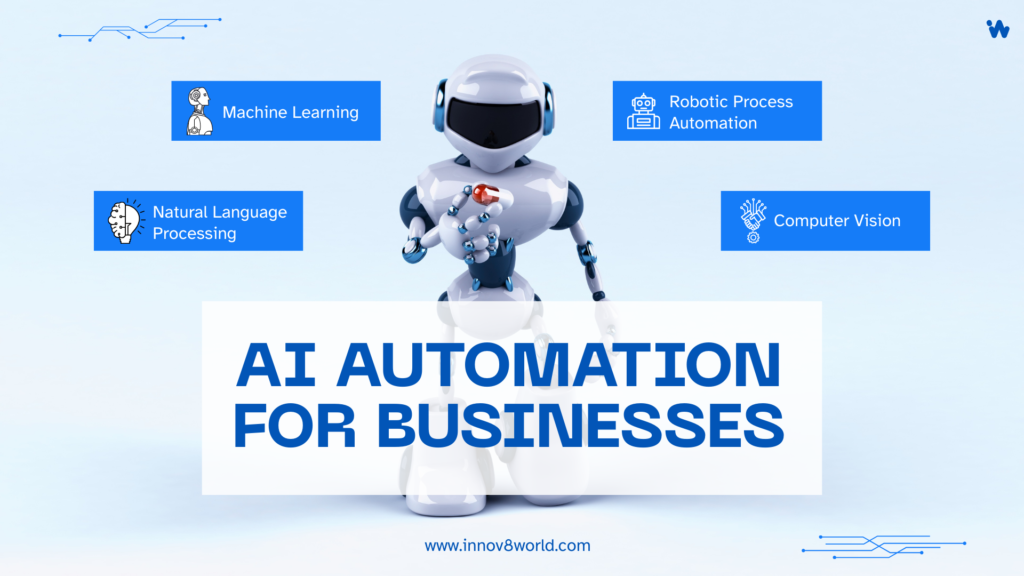
AI automation for businesses is no longer a futuristic concept—it is the backbone of modern enterprise efficiency and growth in 2026. Organizations across the USA, India, UK, UAE, and Australia are leveraging AI tools for business automation to streamline operations, enhance decision-making, and reduce costs.
From small businesses to large enterprises, AI agents for business automation are transforming workflows, eliminating repetitive tasks, and enabling teams to focus on strategic initiatives. In this blog, we explore the most effective AI automation strategies, tools, industry applications, ROI insights, and future trends to help businesses implement automation with precision and confidence.
Understanding AI Automation for Businesses
What is AI Automation?
AI automation refers to the use of artificial intelligence technologies to perform tasks traditionally carried out by humans. Unlike traditional automation, AI automation adapts, learns, and makes intelligent decisions based on data. Key components include:
- Machine Learning (ML): Enables systems to learn from patterns and improve performance.
- Natural Language Processing (NLP): Automates customer support, chatbots, and communication workflows.
- Robotic Process Automation (RPA): Handles repetitive tasks such as invoice processing, data entry, and reporting.
- Computer Vision: Powers retail AI vision automation, inventory management, and quality assurance.
For small businesses, AI automation can optimize workflows without significant IT overhead, while enterprises integrate AI across finance, HR, marketing, and operations to achieve strategic advantages.
Related Links:
- Learn more about AI in Software Development
- Explore AI Companies in India
Types of AI Automation
| Type | Key Function | Ideal For | Examples |
| RPA (Robotic Process Automation) | Automates repetitive tasks | SMBs & Enterprises | Invoice processing, payroll |
| Cognitive Automation | Learns and adapts from data | Enterprises | Predictive analytics, fraud detection |
| Intelligent Agents | Acts autonomously | SMBs & Enterprises | Chatbots, virtual assistants |
| AI Workflow Automation | Integrates AI in processes | Enterprises | N8N AI automation workflows |
| AI Marketing Automation | Enhances customer engagement | SMBs | Email campaigns, lead scoring |
Key Insight: Combining RPA with AI agents for business automation increases accuracy, reduces human error, and frees teams for high-value activities.
Benefits of AI Automation for Businesses
1. Boost Efficiency and Productivity
AI for business automation accelerates operations by handling repetitive and time-consuming tasks. Organizations using AI automation tools for business have reported:
- 40–60% reduction in manual workload
- Faster customer response times with AI-powered chatbots
- Automated data collection and reporting across multiple departments
For example, retail AI vision automation streamlines inventory management and shelf monitoring, enhancing productivity in stores across Mumbai, New York, and London.
2. Cost Reduction and ROI
AI automation for small businesses and enterprises directly impacts the bottom line. Key metrics include:
- Reduced labor costs by up to 30%
- Optimized resource allocation using predictive analytics
- Lower operational errors, saving thousands annually
According to Gartner, businesses implementing AI automation see an average ROI of 20–30% within the first year.
3. Enhanced Decision-Making
AI analytics, combined with workflow automation, empowers leadership teams to make data-driven decisions. Tools like AI automation tools for business consolidate data from multiple sources, providing actionable insights.
Use Case:
- Finance: AI detects anomalies in transactions.
- Marketing: AI marketing automation predicts customer behavior.
- HR: Predictive hiring tools optimize recruitment.
Read More:
- Learn how AI Marketing Automation improves business outcomes.
- Discover HR Software in India for automated employee management.
AI Automation Tools & Platforms for 2026
Must-Have Tools
- UiPath & Automation Anywhere: For RPA and workflow automation.
- Locus Robotics AI: Logistics and warehouse automation.
- N8N AI Automation Workflows: Integrates multiple systems with AI.
- ChatGPT & OpenAI APIs: Customer support and AI agent development.
- HubSpot & Salesforce AI Modules: Marketing and sales automation.
Comparison Table: AI Automation Platforms
| Platform | Primary Use | Small Business Friendly | Enterprise Scalability | Cost (USD) |
| UiPath | RPA | Medium | High | $1,200/mo |
| Automation Anywhere | RPA | Medium | High | $1,000/mo |
| Locus Robotics AI | Logistics Automation | Low | High | Contact Sales |
| N8N AI Workflows | Workflow Integration | High | Medium | Open Source/Enterprise |
| ChatGPT API | Conversational AI | High | High | $0.02 per 1K tokens |
Industry-Specific Applications of AI Automation
1. Retail
- AI-powered checkout systems reduce wait times.
- Inventory prediction with AI vision automation.
- Personalization using AI marketing automation.
2. Manufacturing
- Industrial AI automation for predictive maintenance.
- Robotic arms and sensors optimize production.
- Reduced downtime by 25–30% using AI analytics.
3. Finance
- Fraud detection with AI algorithms.
- Automated compliance reporting.
- Personalized financial recommendations using AI agents for business automation.
4. Healthcare
- Patient data management and diagnosis predictions.
- Robotic process automation for insurance claims.
- AI-driven scheduling and workflow optimization.
- Explore AI in Software Development for healthcare applications.
- Learn more about Custom Software Development.
AI Consulting & Implementation Strategies
Choosing the Right AI Consulting Firm
- Evaluate best AI consulting firms for business process automation.
- Look for case studies demonstrating measurable ROI.
- Ensure the firm understands SMB and enterprise needs.
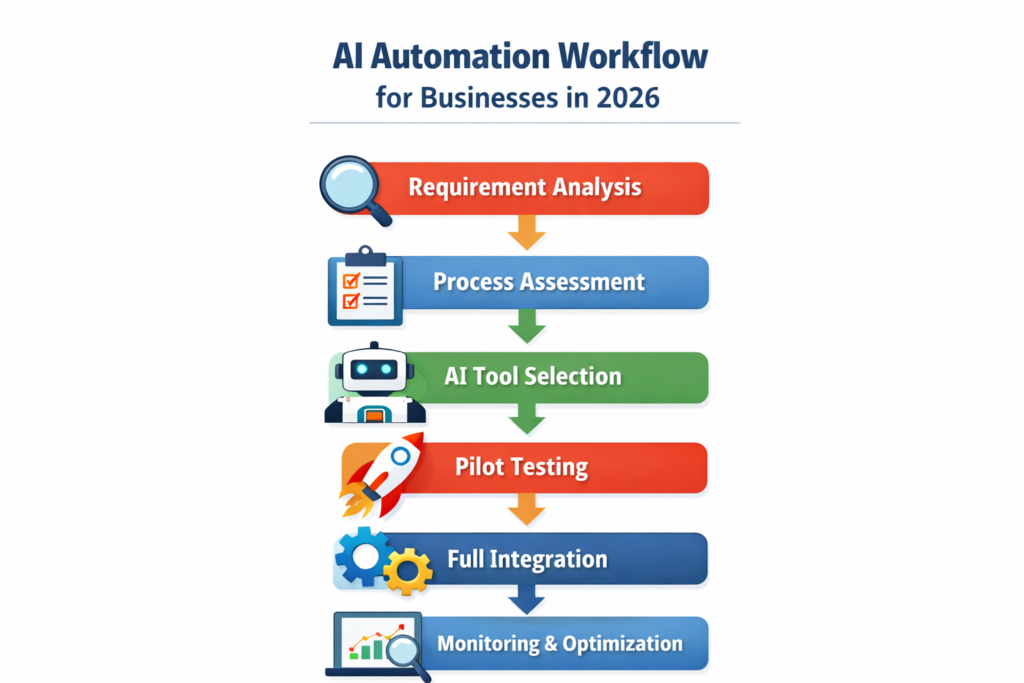
Implementation Steps
- Assessment: Identify processes suitable for AI automation.
- Tool Selection: Choose AI automation tools for business and workflow integration.
- Pilot Testing: Test in a controlled environment.
- Full Deployment: Integrate across departments.
- Continuous Improvement: Monitor AI performance and optimize workflows.
- Hire AI Engineers for tailored automation solutions.
- Explore Software Development Services to integrate AI workflows.
Future Trends in AI Automation for Businesses
- Generative AI for process automation: Automates content creation, reporting, and data analysis.
- Edge AI automation: Real-time processing in manufacturing and IoT devices.
- Hyperautomation: Combining RPA, AI, and ML for end-to-end automation.
- Sustainable AI: Reducing energy consumption and carbon footprint in AI operations.
- LLM-powered automation: AI automation: build LLM apps for business intelligence.
Challenges & Risks of AI Automation
- Ethical AI Concerns: Bias in decision-making and accountability.
- Cybersecurity Threats: Protect AI-driven systems from hacking.
- Workforce Impact: Reskilling employees for AI-enabled workflows.
- Integration Complexity: Ensuring seamless system interoperability.
Mitigating these risks requires strategic planning, skilled developers, and continuous monitoring.
- Learn more about Cybersecurity in Software Development.
Cost, ROI, and Getting Started
- Small businesses: AI automation for small businesses can start at $5,000–$15,000 for workflow integration.
- Enterprises: Full-scale automation projects can exceed $200,000, depending on scale and complexity.
- ROI Metrics: Efficiency gains, cost reduction, revenue increase, customer satisfaction.
Start your AI automation journey today—Contact Innov8World to hire dedicated AI developers and optimize your business processes.
FAQs: AI Automation for Businesses
Q1: What is AI automation for small businesses?
AI automation for small businesses refers to using AI tools to streamline repetitive tasks, improve customer engagement, and reduce operational costs, enabling teams to focus on strategic growth initiatives.
Q2: How much does AI marketing automation cost for small businesses?
Costs typically range from $500 to $2,000 per month, depending on the platform, features, and scale. ROI is measurable through efficiency gains and improved customer engagement.
Q3: What are AI agents for business automation?
AI agents are autonomous programs that perform tasks such as customer support, lead generation, and workflow automation, adapting decisions based on data patterns.
Q4: Which industries benefit most from AI automation?
Retail, manufacturing, finance, and healthcare see significant advantages in efficiency, predictive analytics, and customer personalization through AI automation tools.
Q5: Can AI automation replace employees?
AI automates repetitive tasks, but humans remain essential for strategy, decision-making, and oversight. Reskilling is recommended to complement AI workflows.
Q6: What are the top AI automation tools for 2026?
Top tools include UiPath, Automation Anywhere, Locus Robotics AI, N8N AI automation workflows, and ChatGPT APIs for conversational AI.
Q7: How do I start implementing AI automation in my business?
Assess processes suitable for automation, select tools, conduct pilot tests, integrate AI workflows, and monitor performance for continuous improvement.
Conclusion & Call to Action
AI automation for businesses in 2026 is a game-changer, driving efficiency, reducing costs, and empowering teams to focus on strategic objectives. Whether you are a small business in Mumbai or a large enterprise in New York, leveraging AI tools for business automation ensures you remain competitive in an evolving market.
Partner with Innov8World to hire dedicated AI developers, implement AI workflow automation, and transform your business operations. Schedule a consultation today to begin your AI automation journey.