
Top Benefits of Cloud Native Application Development Services 2025
Cloud native application development has become the cornerstone for building scalable, resilient, and future-ready applications. Traditional monolithic software systems struggle to keep pace with growing user demand, dynamic workloads, and the need for rapid feature delivery. Businesses that continue to rely solely on legacy architectures often face downtime, poor scalability, and higher operational costs, creating a direct impact on customer satisfaction and revenue.
According to a recent CNCF (Cloud Native Computing Foundation) survey, over 96% of organizations are either using or evaluating Kubernetes, the leading platform for cloud-native architectures. The global applications cloud market is projected to grow from $170 billion in 2020 to over $540 billion by 2028, reflecting how critical this approach has become for digital transformation.
This blog explores what is cloud native application development, why it matters, and how you can leverage it to build scalable cloud native apps. We’ll also dive into industry cloud native application development best practices, success stories, tools, and emerging trends that shape the future of native cloud architecture ecosystems. Whether you’re a start-up founder, enterprise CTO, or developer, this comprehensive guide will help you unlock the true power of cloud native architectures.
What is Cloud Native Application Development
At its core, cloud native application development is about designing, building, and running cloud native applications development that fully exploit the advantages of modern cloud native architecture. Unlike legacy systems that rely on monolithic deployments, cloud native apps are built using microservices, containers, orchestration tools like Kubernetes, and continuous delivery pipelines to enable agility, flexibility, and scale.
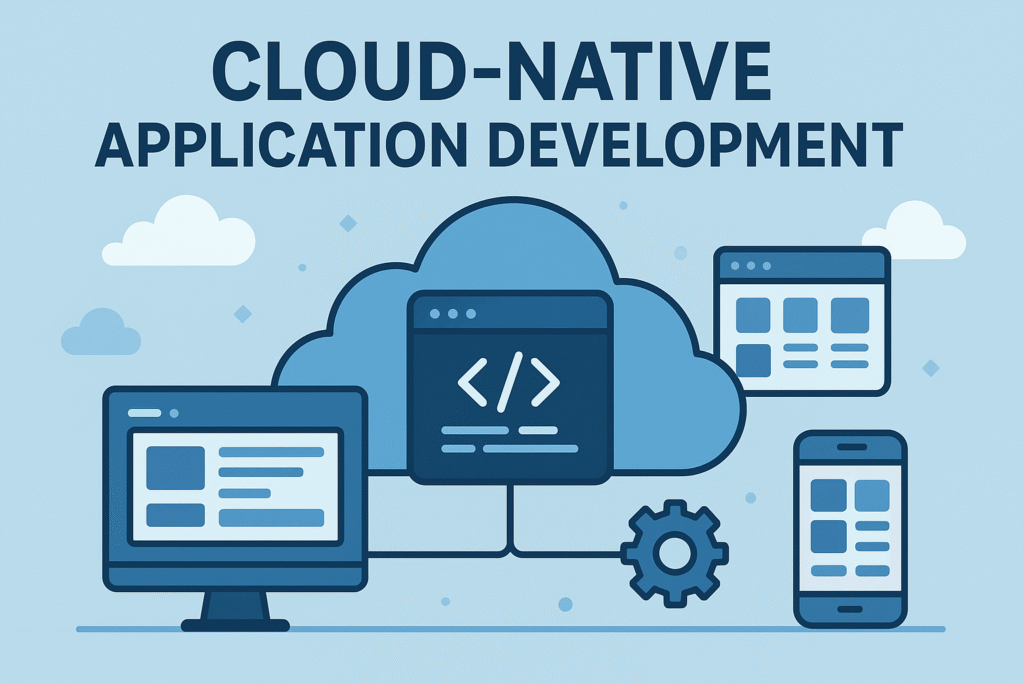
The Cloud Native Computing Foundation (CNCF) defines it as “an approach to building and running cloud native application development that exploit the advantages of the cloud native computing delivery model.” That means cloud native apps are not just hosted in the cloud but are engineered for the cloud—from infrastructure to deployment to monitoring.
Why Cloud Native Application Development Matters for Businesses
Scalability on Demand:
Cloud native apps can automatically scale based on workload. For instance, streaming services like Netflix handle billions of requests daily by dynamically scaling microservices with Kubernetes.
Faster Time-to-Market:
With containerization and CI/CD pipelines, cloud native application developers can deploy updates multiple times a day instead of quarterly. Capital One, for example, reduced deployment cycles from 3 months to just 2 weeks after shifting to cloud native application development services.
Resilience and Fault Tolerance:
Cloud native apps are designed to withstand failures. If one microservice goes down, the rest of the system continues to operate, minimizing downtime and customer frustration.
Optimized Costs:
Instead of over-provisioning servers, businesses pay only for resources used. Pinterest saved millions by containerizing its services and auto-scaling them during traffic spikes, following cloud native application development best practices.
Flexibility Across Cloud Providers:
By using container orchestration and Infrastructure as Code (IaC), companies can avoid vendor lock-in and run cloud native applications across AWS, Azure, Google Cloud, or hybrid environments. Azure users often rely on azure cloud native application development to streamline deployment and scaling.
Key Characteristics of Cloud Native Application Development
To truly understand cloud native application development, let’s break down its defining traits:
- Microservices Architecture – Cloud native apps are split into smaller, loosely coupled services that can be developed, deployed, and scaled independently.
- Containers for Deployment – Tools like Docker and container runtimes package services for portability, a key part of native cloud application development.
- Orchestration with Kubernetes – Automates deployment, scaling, and management of containerized cloud native applications development.
- CI/CD Automation – Ensures continuous integration and delivery of new features with minimal downtime, critical for cloud native application developers.
- Observability – Built-in monitoring, logging, and tracing provide transparency into cloud native architecture performance.
- Infrastructure as Code (IaC) – Platforms like Terraform and AWS CloudFormation enable automated infrastructure provisioning, essential for oracle cloud native application development or multi-cloud deployments.
- Resilience by Design – Systems are built to self-heal, reroute traffic, and handle failures gracefully, following cloud native application development best practices.
💡 Pro tip: A common mistake organizations make is “lifting and shifting” legacy applications to the cloud without rearchitecting them. True cloud native application development methodology goes beyond hosting—it requires reengineering cloud native applications to thrive in a distributed, containerized environment.
Core Components & Tools in Cloud Native Application Development
Cloud native application development services rely on a stack of interconnected tools and practices that help cloud native application developers build, deploy, and manage scalable cloud native apps. These components form the backbone of any modern digital product that aims to thrive in today’s cloud native architecture-driven economy.
1. Microservices Architecture
One of the cornerstones of cloud native applications development is the shift from monolithic applications to cloud native architectures.
- Monolithic apps bundle all features into a single codebase, making them hard to scale or update.
- Cloud native apps break applications into independent, loosely coupled services—each focused on a specific business capability (e.g., payment processing, user authentication, recommendation engine).
Benefits:
- Independent scaling of services
- Faster deployments and updates
- Easier debugging and failure isolation
- Team autonomy for parallel development
Example: Netflix migrated to cloud native apps to handle over 200 million users, ensuring uninterrupted streaming even during peak traffic.
2. Containers for Application Packaging
Containers (powered by Docker, Podman, etc.) are the building blocks of cloud native application development.
- They package applications and dependencies together, ensuring consistency across development, testing, and production environments.
- Containers enable portability across cloud providers—whether it’s AWS, Azure, or suse cloud native application development environments.
Why containers matter:
- Lightweight and faster than virtual machines
- Portable across operating systems
- Ideal for CI/CD pipelines
Pro tip: Always use container registries (e.g., Docker Hub, Amazon ECR) for secure cloud native applications development management.
3. Container Orchestration with Kubernetes
If containers are the bricks, Kubernetes (K8s) is the architect. It’s the most widely used orchestration platform in cloud native application development methodology.
Kubernetes capabilities include:
- Automated scaling (up or down based on demand)
- Self-healing (restarts failed containers automatically)
- Load balancing
- Declarative configuration (IaC)
- Seamless rolling updates
💡 According to CNCF, over 96% of organizations are running or evaluating Kubernetes in production environments—making it the de facto standard for cloud native application developers.
4. Continuous Integration & Continuous Deployment (CI/CD)
A cloud native application development methodology relies heavily on automated CI/CD pipelines. Instead of long release cycles, businesses can deploy multiple updates daily.
Popular CI/CD Tools for cloud native application development services:
- Jenkins – Flexible, open-source automation server
- GitLab CI/CD – Built-in pipelines with Git repository integration
- GitHub Actions – Workflow automation with seamless GitHub integration
- Argo CD – Kubernetes-native GitOps continuous delivery tool for cloud native apps
Key benefits:
- Reduced human errors
- Faster time-to-market
- Consistency across environments
- Enhanced productivity for cloud native application developers
Example: Capital One scaled its cloud native application development CI/CD pipeline to push 50+ deployments daily, reducing release cycles dramatically.
5. Infrastructure as Code (IaC)
Instead of manually configuring servers, IaC enables teams to define and manage infrastructure using code—a critical part of oracle cloud native application development or azure cloud native application development.
Common IaC tools for cloud native applications development:
- Terraform – Multi-cloud provisioning with reusable templates
- AWS CloudFormation – Native IaC for AWS resources
- Pulumi – Uses programming languages (Python, Go, JavaScript) for IaC
- Ansible – Automation for configuration management and orchestration
Why IaC is essential:
- Repeatability and consistency
- Version-controlled infrastructure
- Faster disaster recovery
- Enables native cloud application development across multiple platforms
6. Observability, Monitoring & Logging
In cloud native applications development, observability is critical for uptime and performance.
Three pillars:
- Logging – Collects detailed application logs (ELK stack: Elasticsearch, Logstash, Kibana)
- Metrics – Provides performance data (Prometheus, Datadog, Grafana)
- Tracing – Tracks requests across cloud native architecture microservices (Jaeger, OpenTelemetry)
💡 Pro tip: Combine metrics + logs + tracing for a 360-degree view of your cloud native apps performance.
7. Security & Compliance
Security must be integrated into cloud native application development best practices, not bolted on.
Best practices for cloud-native security:
- Implement zero-trust architecture
- Regular vulnerability scanning of cloud native apps container images (e.g., Aqua, Trivy)
- Enforce role-based access control (RBAC) in Kubernetes
- Use service meshes like Istio for secure communication between cloud native applications
✅ Quick Summary:
A robust cloud native application development strategy integrates:
- Microservices + Containers + Kubernetes
- CI/CD pipelines
- IaC for automated provisioning
- Observability tools for performance
- Strong security from day one
Together, these components enable resilient, portable, and scalable cloud native applications development.
Best Practices for Cloud Native Application Development
Adopting cloud native application development services goes beyond simply deploying containers or using Kubernetes. Key practices include:
- Design for Microservices First – Each microservice should serve a single business function and communicate via APIs. This is a cornerstone of cloud native application development methodology.
- Embrace Containerization – Use lightweight base images and secure registries for cloud native apps.
- Automate with CI/CD Pipelines – Ensure continuous delivery for cloud native applications development.
- Apply Infrastructure as Code (IaC) – Automate provisioning for oracle cloud native application development or azure cloud native application development environments.
- Implement Observability from Day One – Monitor cloud native architecture with Prometheus + Grafana dashboards.
- Prioritize Resilience and Fault Tolerance – Use circuit breakers, retry strategies, and chaos engineering for cloud native applications.
- Strengthen Security in Every Layer – Follow cloud native application development best practices for zero-trust and secure communication.
- Avoid Vendor Lock-In – Leverage cloud native architectures standards to ensure portability.
- Focus on Cost Optimization – Use auto-scaling rules and serverless functions for cloud native apps.
- Foster a DevOps & Agile Culture – Critical for cloud native application developers to collaborate effectively.
Quick Recap: Cloud Native Application Development
By following these cloud-native best practices, organizations ensure their applications are:
- Scalable → via microservices, Kubernetes, and IaC
- Reliable → with resilience and observability baked in
- Secure → with zero-trust and automated scanning
- Cost-efficient → through automation and optimization
💡 Businesses that implement these strategies report up to 30–50% faster delivery times and 20–40% lower infrastructure costs compared to traditional methods.
Scalability in Cloud Native Application Development
ScScalability is the true test of cloud native application development, ensuring your cloud native apps handle real-world demand efficiently. It’s not enough to simply deploy cloud native applications on Kubernetes or adopt microservices—teams need to measure and benchmark performance under real-world conditions to ensure cloud native architectures remain reliable at scale.
Why Scalability Matters
- User Growth: Cloud native apps like TikTok, Netflix, or Zoom handle billions of requests daily; cloud native application development best practices ensure performance does not degrade with demand.
- Dynamic Workloads: E-commerce apps face unpredictable spikes; cloud native applications development scales automatically to save costs.
- Global Distribution: Businesses expanding globally require multi-region deployments with native cloud architecture and geo-redundancy.
💡 Stat: According to IDC, over 80% of enterprises report scalability as the #1 driver for adopting cloud-native architectures.
Key Scalability Metrics to Track
To benchmark cloud native application development, organizations should measure:
- Requests per Second (RPS) – Throughput under load
- Latency – Response time of cloud native apps
- Error Rate – Percentage of failed requests during stress testing
- Resource Utilization – CPU, memory, and I/O efficiency per cloud native application
- Autoscaling Efficiency – Time taken by orchestration (Kubernetes HPA) to scale pods for cloud native applications development
Tools for Benchmarking:
Kube-burner → CNCF project for cloud native architectures performance benchmarks
Apache JMeter → Load testing for cloud native application development services
Locust → Python-based load testing for cloud native apps
K6 → Developer-centric load testing for cloud native applications
Success Stories & Industry Use Cases of Cloud Native Application Development
Cloud native application development services are proven strategies that enterprises leverage to scale faster, reduce costs, and stay competitive.
1. ElasticBLAST (Bioinformatics Cloud Platform)
Native cloud application development by NCBI enables researchers to run massive bioinformatics searches.
- Built on Kubernetes + AWS
- Scales to thousands of queries simultaneously
- Reduces processing time from days to hours
Insight: Cloud native application development best practices transform research workflows, not just consumer apps.
2. Pinterest
Pinterest transitioned from a monolith to over 1,000 microservices, following cloud native application development methodology.
- Kubernetes autoscaling reduced downtime during traffic surges
- Millions saved in infrastructure costs
- Faster feature rollouts boosted engagement of cloud native apps
3. Capital One
As a pioneer in cloud native application development, Capital One leveraged:
- Microservices + CI/CD pipelines
- Kubernetes orchestration for secure deployments
- Cloud native applications development best practices for scalability
Result: Deployment cycles dropped from 3 months to just 2 weeks, with near-zero downtime.
4. Zoom (Pandemic Growth Story)
Zoom scaled from 10M to 300M daily users using cloud native architecture.
- Hybrid cloud native applications development across regions
- Dynamic scaling to meet unprecedented demand
Scalability Best Practices
From research + real-world cases, the following practices stand out:
- Load Testing Early & Often: Run stress tests before production rollout.
- Use Horizontal Pod Autoscaling (HPA): Scale out instead of up for cost efficiency.
- Embrace Multi-Region Deployments: Improve reliability and reduce latency.
- Integrate Observability: Metrics-driven scaling ensures performance under load.
- Apply Chaos Engineering: Test failures to build true resilience.
✅ Quick Recap:
Cloud-native scalability is measurable, testable, and improvable. By adopting empirical benchmarking methods, leveraging Kubernetes autoscaling, and learning from pioneers like Pinterest and Capital One, businesses can deliver applications that scale seamlessly under global demand.
Success Stories & Industry Use Cases in Cloud Native Application Development
Cloud-native application development is not just a buzzword—it’s a proven strategy that leading enterprises across industries are leveraging to scale faster, reduce costs, and stay competitive. Let’s explore how different sectors are adopting cloud-native architectures and what others can learn from them.
1. Financial Services – Capital One & Goldman Sachs
Capital One became one of the first major banks to embrace cloud-native development at scale. By adopting microservices, Kubernetes, and CI/CD pipelines, it reduced deployment times from months to weeks.
- Challenge: Legacy infrastructure slowed innovation and compliance updates.
- Solution: Migrated critical workloads to AWS using containers and Infrastructure as Code (IaC).
- Result: Continuous innovation with faster delivery and stronger compliance.
Similarly, Goldman Sachs used cloud-native architectures to power Marquee, its digital platform for institutional clients. By using Kubernetes and observability tools, the bank ensured secure, resilient financial services that meet strict regulatory standards.
2. Healthcare – Philips & Epic Systems
Philips Healthcare developed cloud-native imaging and diagnostic platforms to deliver faster, scalable healthcare services across hospitals.
- Challenge: Need to process terabytes of imaging data quickly and securely.
- Solution: Adopted container-based workloads with Kubernetes orchestration.
- Result: Hospitals scaled workloads seamlessly, enabling faster diagnoses for patients.
Epic Systems, a leading electronic health record (EHR) provider, migrated to cloud-native solutions to handle millions of patient records. With serverless computing + observability, it ensured 99.99% uptime, even during COVID-19 surges.
3. Retail & eCommerce – Pinterest & Shopify
Pinterest handles over 450 million active users monthly and relies on Kubernetes + microservices to manage seasonal spikes (e.g., holiday shopping).
- Result: Reduced downtime, millions saved in infrastructure costs, and faster feature rollouts.
Shopify, which powers over 4.5 million eCommerce stores, uses cloud-native scalability to handle peak shopping days like Black Friday.
- With Kubernetes autoscaling, Shopify can process hundreds of thousands of orders per minute without slowing down.
- By integrating observability + chaos engineering, Shopify ensures reliability during peak global demand.
4. Telecom & 5G – Wind River & AT&T
Wind River is a global leader in 5G cloud-native platforms, recognized as the top-ranked solution for operators (Wind River Studio).
- Challenge: Telecom providers need ultra-low latency and high availability.
- Solution: Built cloud-native, edge-based platforms for 5G networks.
- Result: Enabled telecoms to deliver scalable 5G infrastructure from edge to core.
AT&T adopted a cloud-native strategy for its 5G core network, using containers, microservices, and service meshes for reliable communication.
- Impact: Millions of users benefit from faster connectivity and lower latency in real time.
5. Technology & Entertainment – Netflix, Uber & Zoom
- Netflix: The poster child of cloud-native success. Runs thousands of microservices on AWS, orchestrated by Kubernetes. Netflix can deploy code hundreds of times daily and scale globally to support 200M+ subscribers.
- Uber: Uses cloud-native microservices and observability to power ride-hailing, food delivery, and payments. Scaling algorithms ensure reliability during demand surges (e.g., New Year’s Eve).
- Zoom: During the pandemic, Zoom scaled from 10M to 300M daily users in months using a hybrid cloud-native architecture. Kubernetes clusters across regions handled traffic seamlessly.
6. Public Sector & Research – NASA & ElasticBLAST
- NASA leverages cloud-native solutions for satellite imaging, space exploration analytics, and AI-driven simulations. With containers and Kubernetes, NASA processes petabytes of data in real time.
- ElasticBLAST (NCBI): A cloud-native bioinformatics app that allows scientists to run massive BLAST searches on genomic data. It uses Kubernetes on AWS/GCP to scale jobs across thousands of compute nodes.
Lessons Across Industries
From finance to healthcare to retail, the patterns of success in cloud-native development are consistent:
- Microservices + Containers = Agility
- Kubernetes Orchestration = Scalability
- CI/CD Pipelines = Faster Innovation
- Observability = Reliability at Scale
- IaC & Security by Design = Compliance + Trust
💡 Key takeaway: Cloud-native development is not industry-specific. Whether you’re building fintech apps, healthcare platforms, eCommerce systems, or even government research projects, the same principles apply universally—with tailored implementations for sector needs.
✅ Quick Recap:
Cloud-native success is visible everywhere—from banks cutting release cycles to retailers scaling for global shoppers, from telecoms enabling 5G to scientists accelerating discoveries. Enterprises adopting these strategies are not just future-proofing—they’re setting industry benchmarks.
Trends, Influencers & the Future of Cloud-Native Development
Cloud native application development evolves with new technologies, AI, edge computing, and sustainability.
Future Trends
- AI-Powered Cloud-Native Development
- AI Ops tools predict failures in cloud native apps
- ML-driven cloud native applications development enable predictive analytics
- Edge Computing + Cloud-Native at the Edge
- Telecoms and IoT firms use cloud native architectures at the edge
- Example: AT&T leverages cloud native application development services for 5G networks
- Serverless Architectures for Faster Delivery
- Developers focus on code for cloud native apps, while cloud providers manage infrastructure
- Security-First Cloud-Native Development
- DevSecOps integrates security into cloud native application development methodology
- Tools like Aqua Security scan cloud native apps at build time
- Sustainability & Green Cloud-Native Computing
- Kubernetes clusters auto-scale to save energy in cloud native applications development
- Enterprises adopting cloud native application development best practices align with ESG goals
Influencers
- Priyanka Sharma (CNCF) – Advocate for cloud native architectures
- Kelsey Hightower – Developer-first cloud native application developer guidance
- Brendan Burns – Co-creator of Kubernetes influencing cloud native application development methodology
👉 Following these leaders ensures that enterprises adopt future-ready strategies aligned with the global CNCF (Cloud Native Computing Foundation) ecosystem.
What the Future Holds for Cloud Native Application Development
- AI + Cloud-Native = Cognitive Applications
Future apps will use AI at the core—from autonomous retail checkouts to intelligent healthcare diagnostics. - Hybrid & Multi-Cloud Ecosystems Will Dominate
Enterprises won’t rely on a single provider. Instead, they’ll deploy apps across AWS, Azure, GCP, and private clouds for flexibility. - Industry-Specific Cloud-Native Platforms
Expect vertical-specific cloud-native solutions: FinTech clouds, HealthTech clouds, EduTech clouds, etc. - Rise of Cloud-Native Talent & Communities
CNCF reports 3.9M Kubernetes developers worldwide, growing 40% YoY. Skilled developers will shape the next wave of innovation.
✅ Quick Recap:
The future of cloud-native development lies at the intersection of AI, serverless, edge computing, and sustainability. With strong leadership from the CNCF community and rapid enterprise adoption, cloud-native applications will define how every industry innovates at scale.
FAQ‘s on Cloud Native Application Development
What is cloud-native development?
Cloud native application development is building and running cloud native apps that leverage modern cloud native architectures using microservices, containers, and CI/CD pipelines.
Benefits of cloud-native applications?
- Scalability with cloud native apps
- Resilience in cloud native applications development
- Faster time-to-market with CI/CD
- Cost-efficient cloud native application development services
- Flexibility across cloud native architectures
Is Kubernetes mandatory?
Not mandatory, but most cloud native application developers use it for orchestration. Alternatives include Docker Swarm, Nomad, or managed services like AWS ECS and Azure for azure cloud native application development.
Industries benefiting the most?
Finance, Healthcare, E-commerce, Logistics, Media, and more use cloud native application development.
Supports DevOps & CI/CD?
Automation in cloud native applications development ensures fast, reliable, and zero-downtime deployments.
Suitable for startups and SMEs?
Yes, cloud native application development services reduce costs and enable rapid experimentation.
Future of cloud-native development?
AI, serverless, edge computing, and sustainable cloud native application development best practices will define the next wave.
📌 In short: Cloud-native is not just a trend—it’s the foundation of digital transformation across industries.
Are you ready to embrace Cloud native application development and build applications that scale effortlessly, remain resilient under pressure, and accelerate innovation?
At Innov8World, we help businesses design, develop, and deploy cloud-native applications tailored to their unique needs. Whether you’re a startup looking to disrupt the market or an enterprise modernizing legacy systems, our expertise in Kubernetes, microservices, DevOps, and CI/CD ensures your digital success.
👉 Explore more on our Web3 development services and discover how next-gen technologies can further strengthen your cloud-native journey.
Conclusion on Cloud-Native Development
Cloud native application development is no longer optional—it’s a strategic necessity in today’s competitive digital landscape. By leveraging microservices, containers, Kubernetes, DevOps, and modern cloud native architectures, organizations can achieve:
- Scalability to handle traffic surges seamlessly with cloud native apps
- Resilience to ensure uptime and reliability in cloud native applications development
- Speed with faster releases through CI/CD for cloud native application development services
- Cost savings via optimized native cloud application development
From fintech and healthcare to e-commerce and logistics, businesses across industries prove that cloud native applications development is the backbone of digital transformation.
As Gartner and Forbes predict, companies adopting cloud native application development methodology outperform competitors in innovation, scalability, and customer experience.
Final Thought
Now is the time to invest in cloud native application development. Partner with experts to:
- Build resilient cloud native apps that scale effortlessly
- Follow cloud native application development best practices for secure, reliable deployments
- Implement oracle cloud native application development or azure cloud native application development as per your ecosystem
- Leverage cloud native architectures for future-ready digital transformation
At Innov8World, we provide cloud native application development services, helping startups and enterprises design, develop, and deploy cloud native applications tailored to their unique needs. Our team of cloud native application developers ensures success across Kubernetes, microservices, CI/CD pipelines, and multi-cloud environments.
👉 Explore more on our Web3 development services and discover how next-gen technologies can further strengthen your cloud native application development journey.
Invest in Cloud Native Application Development today and future-proof your business for the cloud-first era!